On Curiosity


The end of July is always takes me by surprise. Even more so since making the transition from faculty to educational developer, where August is one of the busiest months of our calendar year (orienting new faculty, running summer teaching institutes).
But wait! What happened to summer? Further disorienting is that in New England the tomatoes are just getting started. Surely I should still be on the beach? Ah well.
BE THE SPARK - Thoughts on Teaching and Learning
I love this recent research on curiosity, which endeavored to answer the question: does satiating curiosity end the information-seeking loop and thus dampen curiosity, or does the satisfaction of a successful information quest serve as reinforcement, thereby increasing future curiosity? Good news for us in the business of engaging students with learning, it is the latter. Feeling curious and then learning information that resolves that curiosity makes it more likely you'll be curious in the future – and interestingly, this seems to be an effect that is most true of similar information. Students who experience curiosity in a STEM class and have that successfully resolved through learning may thus be more likely to be curious about STEM-related matters in the future. Curiosity engenders engagement and learning, and learning reinforces curiosity.
That I am intrigued by this intersection of emotion (affect!) and learning (cognition!) leads me to more thinking and feeling news.... which is a teaser for the upcoming project the marvelous Dr. Pooja Agarwal and I are currently working on. Stay tuned for the "reveal," likely in these pages and elsewhere this fall...
Staying on theme because why not, I loved this short piece in The Atlantic about how in our mad quest to simplify, speed up, and return-on-investment higher education, "[w]e’ve forgotten the most important thing of all—that thinking can be deeply pleasurable." In the essay Michael Elliot makes the case that not only should leading students to understand the joy of the life of the mind be a goal in and of itself, it is precisely such joy in uncertainty and debate that may serve as a counter to the intellectual and moral erosion of our modern times of polarization, precarity, and misinformation. It is "the play of ideas is the essential counterweight to both intellectual laziness and rigid dogma," he writes.
Enjoy:
 Michael A. Elliott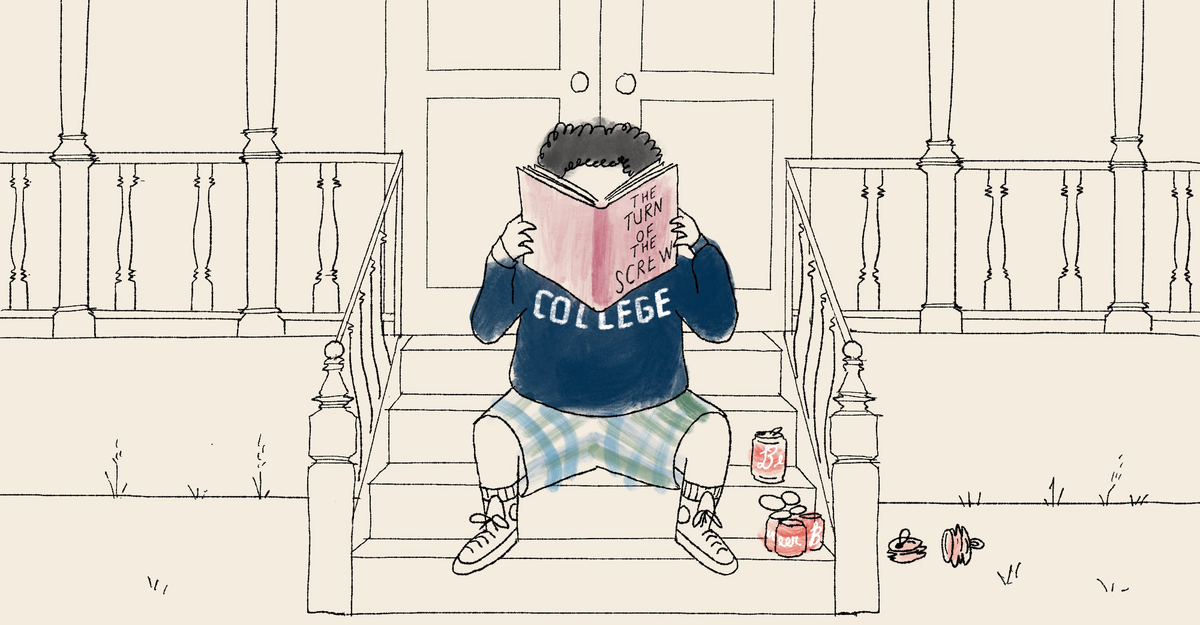
Rounding out this tour of recent work on curiosity, I'm getting increasingly excited for Bethany Lisi's upcoming book The Jolt to Explore which is a focused primer on curiosity and learning and how to apply it in higher education. It doesn't look like it is available to pre-order yet, but you can catch some of her thinking in this podcast episode.
STRIVING - Emotion, Motivation, Our Synchronous Selves
Despite my best efforts, progress on my new book on happiness has been slow-going, but I got a good boost recently from putting together a new fall course for Simmons University called And the Pursuit of Happiness? It is a course designed by one of my psychology colleagues but for an online rather than our on-site program, so I'm having fun making it my own.
We're going to consider what the psychological research has to say about what makes us happy... and what does not. Just a few of our candidates for things that may (or may not) make us happy: money, sleep, sex, relationships, purpose, cults, friendship, quitting tech, green spaces, emotion regulation, altruism, goal-setting, and religiosity.
Someone wise once said you should write like a teacher, so I'm hoping over the following months putting together activities, anecdotes, lecture slides, and assessments will make it easy to write, write, write.
OUR MONSTERS, OURSELVES - Uncertainty, Challenges, Mental Health
The book The Anxious Generation: How the Great Rewiring of Childhood is Causing an Epidemic of Mental Illness by Jonathan Haidt offers two central arguments for a spike in youth mental struggles: that burdened by our own parental anxieties, we greatly restricted youth freedom and play and that we handed them phones (loaded with social media) instead. Haidt's solution is to take the phones away and age-restrict access to social media. Many credit this book with the widespread phone bans in American schools. While Haidt does also encourage parents to create more opportunities for physical play, I've always felt there is still a blatant contradiction in his recommendations. Being overprotective about possible dangers at large in the world and correspondingly curtailing the freedom of youth leads to worse mental health, thus let's ... be overprotective and curtail their freedom in a whole other way?
Thus I was fascinated to read about a falling out between Haidt and Peter Gray, one of his friends and the names most associated with the "free play" movement he champions.
 Kaitlyn Tiffany
But when Gray first read the manuscript in his lofted study overlooking the river, he was appalled. “The book frankly makes me mad,” he told me. “I have to say that. I think it’s unethical.” Although The Anxious Generation goes on at length about the benefits of free play, and even makes specific mention of Let Grow, its message overall was for Gray inimical to the nonprofit’s mission. As he sees it, the analysis improbably suggests that taking away phones would prompt kids to run around exploring as their grandparents had done. The few freedoms that kids had left were private communications with their friends and some independent movement, permitted only so long as they could be tracked and called. More than that, Haidt’s book implies that kids cannot be trusted to delve into the online world on their own, or even taught to do it safely. The internet is too dangerous for children—too full of scary strangers and powerful temptations—much in the same way that parents and pundits had decried the perils of the physical world generations before. Haidt had wanted feedback on the manuscript. Gray told him he disagreed with its premise.
In my own book on how social media may be reshaping our mental lives and the lives of our youth, I lean heavily on dana boyd's analysis of qualitative interviews with actual young people who report just what Gray argues here - that exploring the social world with each other mediated by phones was one of the only areas left not surveilled by their parents. Where they felt they could play around with identities, share openly, and explore. Where they could explore their curiosities.
(And in my own book on the youth mental health crisis, my review of the literature suggests the causes and possible solutions are a whole lot more complicated and nuanced than "it's the phones.")
I'm certainly not opposed to reining in tech companies' unfettered access to the minds of our youth, and as a parent I regulated both phone and screen use a fair amount. But as I've argued elsewhere, I believe what our youth need in learning to live healthfully in a technological world is akin to what they need to learn to live healthfully in a sexual world - not abstinence-based approaches but education, open conversations, and good modeling.
INCIDENTALLY - What To Do With All That Squash
Our new CSA has a variety of pattypan zucchini that is the best I have ever tasted. My favorite dish yet for it is a seared squash and halloumi dish. If you have access to the amazing Angel Bakeries pita and warm some up in the oven with fresh garden herbs, it makes for an excellent pairing. If you too are buried in squash and curious what to do with it.... this is peak summer eating.